
Some storage move-outs leave behind a few dust bunnies, a lonely coat hanger, or one mysterious phone charger. This one left behind something far more summer-ready: a kayak.
There it was, sitting like it had been waiting for its big moment. Not tucked away in a corner. Not hidden under a tarp. Just a full-on kayak, bright with vacation energy, looking like it had taken a wrong turn on the way to the lake and ended up in a rental property instead.
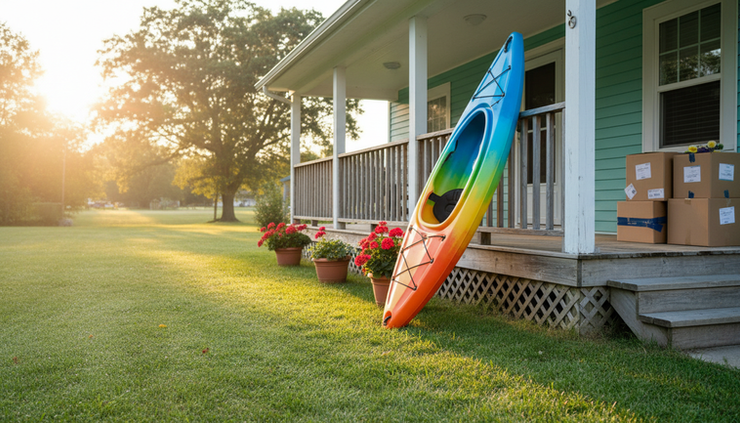
The move-out item no one saw coming
Every property has its own little post-move-out story. Sometimes it is a drawer full of takeout menus. Sometimes it is a forgotten bicycle with one flat tire. Sometimes it is a stack of holiday decorations that missed their season by several months.
And sometimes, it is a kayak.
You never really know what waits behind the garage door, in the shed, or along the side yard. Most leftover items are ordinary. A kayak is not ordinary. It feels like an entire summer plan got paused mid-sentence.
Maybe it was part of a weekend hobby. Maybe it belonged to a roommate. Maybe it was too awkward to load on moving day. Kayaks are not exactly “grab it and go” items. They are long, bulky, and stubborn in a way that makes every hallway, fence gate, and truck bed feel smaller than it really is.
Still, it made the whole cleanout feel less like a chore and more like a treasure hunt.
The kayak had personality. It brought instant questions:
Where had it been?
Was it a lake kayak, a river kayak, or a “bought with big plans” kayak?
How many summers did it see?
Why was this the item that did not make the final moving truck?
No one may ever know the full story. That almost makes it better.
Summer was written all over it
A kayak is not just an object. It comes with a whole mood.
You see one and think of warm afternoons, sunscreen, water shoes, cold drinks in a cooler, and that peaceful stretch of time when no one is checking the clock. It brings to mind the gentle scrape of plastic on a boat ramp, the sound of paddles dipping into water, and the tiny thrill of pushing away from shore.
Finding one after a tenant leaves feels funny because it is so specific. A couch makes sense. A lamp makes sense. Even an old grill makes sense. But a kayak feels like the property briefly became a lake house, even if the nearest water was miles away.
There is something charming about finding a summer adventure left behind. It turns a routine walkthrough into a tiny story worth retelling. The kind of story that starts with, “You will not believe what was still there.”

Why big leftover items become move-out mysteries
Large items get left behind more often than people expect. Not every tenant leaves them because they do not care. Many leftover items are the result of timing, transport, storage limits, or simple moving-day stress.
A kayak checks every box for “hard to move.”
It usually needs:
A roof rack, truck, trailer, or larger vehicle
Tie-down straps that are actually long enough
Someone willing to lift and carry it
A place to store it at the next home
Enough time to deal with it before the keys are turned in
That last part is often the dealbreaker.
Moving day has a way of shrinking plans. The item that seemed manageable on Tuesday becomes a giant problem by Saturday afternoon. Boxes are everywhere. The rental truck is full. The weather is hot. Everyone is tired. Then someone looks at the kayak and says the phrase that has launched a thousand leftover-item stories:
“We’ll come back for it.”
Sometimes they do. Sometimes they do not.
A kayak can also become a storage problem. Many apartments, townhomes, and smaller houses do not have a good place for one. It might not fit in a closet, balcony rules may not allow it, and leaving it outside can cause wear over time. So the tenant may plan to sell it, gift it, or pick it up later, then life moves on.
That does not make the situation less surprising for the person doing the turnover. It just makes the kayak feel like the final chapter of a very busy move.

What the kayak says about move-out season
Move-outs often happen during the warmer months. Summer is a busy time for leases, relocations, student moves, job changes, and family transitions. That means more cleanouts, more quick turnarounds, and more surprises waiting in garages and sheds.
The season adds its own flavor. In winter, leftover items might be space heaters, snow shovels, or boxes of decorations. In summer, the forgotten things get a little more playful:
Pool floats that lost their air
Patio chairs missing one cushion
Coolers with faded stickers
Beach umbrellas with bent poles
Grills that have seen better cookouts
Garden tools with a full season of dirt on them
And, every once in a while, a kayak ready for its close-up
These items tell a story about how people used the space. A home is not just walls and rent payments. It holds routines, hobbies, weekend plans, and spur-of-the-moment purchases. When someone moves out, a few pieces of that life can get left behind.
Most of the time, those pieces are forgettable. The kayak was not.
It made the property feel briefly connected to lakes, rivers, and road trips. It also reminded everyone that move-outs have a sense of humor.

A bright reminder from one forgotten kayak
The best part of this summer surprise was not just the kayak itself. It was the reminder that every property has a story after the moving truck leaves.
Some stories are dusty. Some are strange. Some involve mystery cords, half-used paint cans, or a single chair in an empty room.
And once in a while, the story is shaped like a kayak.
A simple cleanout became a sunny little moment, proof that even routine move-outs can still float something unexpected to the surface.

